Your Google ranking and your AI ranking.
One report.
Your client’s customers ask ChatGPT, Gemini and Perplexity for recommendations — and Google answers a quarter of searches with an AI Overview before anyone clicks. GEO reporting puts that new visibility next to the classic rankings, in the same branded report you already send.
DEFINITION
What is GEO reporting?
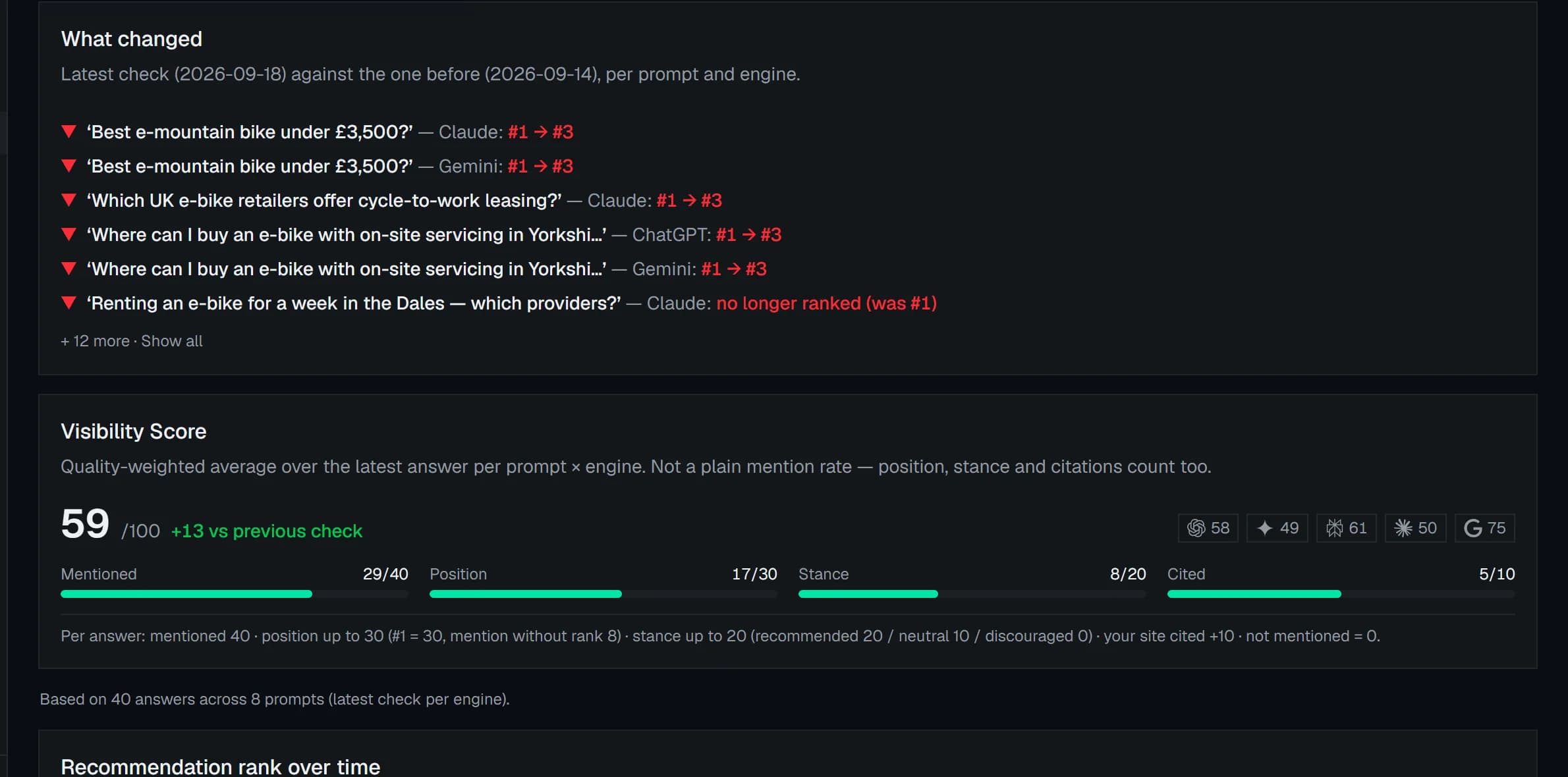
GEO reportingis the practice of tracking a brand’s visibility in AI answer engines — ChatGPT, Gemini, Perplexity, Claude, Google’s AI Overviews — and delivering it as a recurring line item in the client report, alongside organic rankings, traffic and site health.
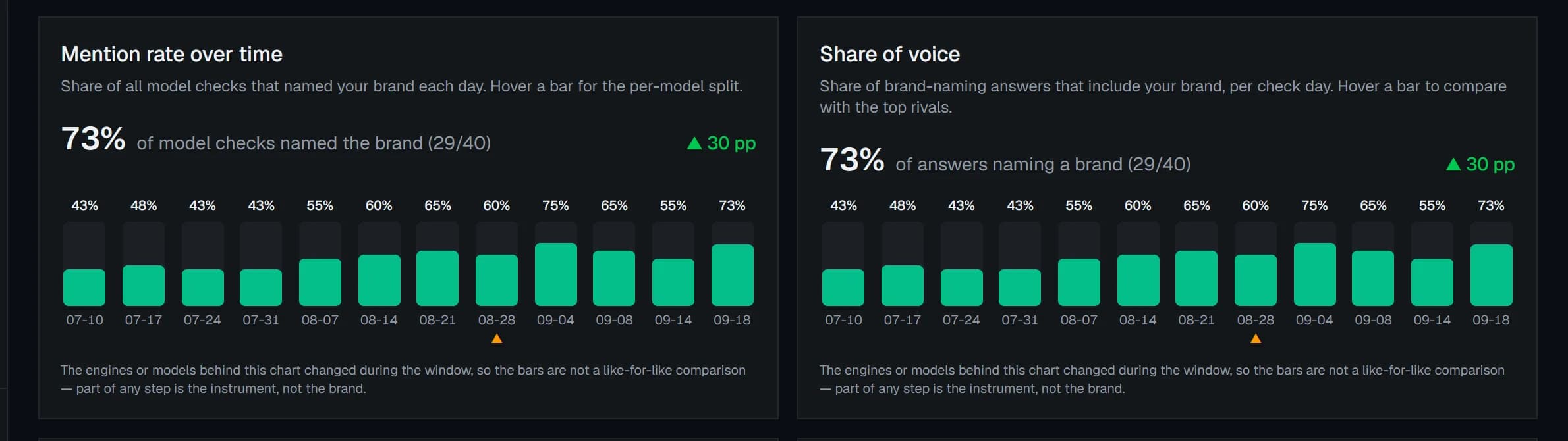
It answers the question every client has started asking: “Do we show up when someone asks the AI?” — with a measured yes/no per prompt, per engine, per week. Not a one-off audit. A metric with a trend line, in the report they already read.
WHY NOW
Tuesday, 14:10. The client’s marketing lead forwards a screenshot: ChatGPT recommending three competitors for the exact service they pay you to rank them for. “Do we show up in this? Can we?” You have their Google rankings, their traffic, their backlinks. You have nothing on this.
That is the moment GEO reporting exists for. Not a new dashboard for its own sake — a page in the report you already send that answers the question the client now asks every quarter: named or not, by which engines, citing which sources, and whether it moved since last time. Measured on a schedule, so the answer is ready before the screenshot arrives.
IN THE REPORT
What your client actually sees.
Prompt watchlist
Track the questions that matter — “best [category] in [city]” — and see which engines mention the brand, with the full answers archived.
5-engine mention matrix
ChatGPT, Gemini, Perplexity, Claude and Google AI Mode checked weekly. A ✓/✗ per prompt per engine, plus who the models recommend instead.
AI Overview citations
For every tracked keyword: does Google show an AI Overview — and is your client cited as a source in it, or is a competitor?
Next to the rankings
The AI columns live in the same tracked-rankings table as positions and movement. One story: here’s Google, here’s AI, here’s the gap.
And because it’s datareport.ai, the same report carries uptime, site health, accessibility (EAA/WCAG), Core Web Vitals and analytics — AI-narrated, white-label, EU-hosted.
FAQ
Questions agencies ask about GEO reporting.
What is GEO reporting and how is it different from SEO reporting?
GEO reporting tracks whether a brand shows up in AI answer engines — ChatGPT, Gemini, Perplexity, Claude and Google AI Overviews — while SEO reporting tracks where it ranks in Google’s blue links. GEO reporting measures citations and mentions in AI answers; SEO reporting measures ranking positions. datareport.ai puts both in one client report so the AI columns sit next to the Google rankings.
Which AI engines does GEO reporting cover?
datareport.ai GEO reporting covers five engines: ChatGPT, Gemini, Perplexity, Claude and Google AI Overviews. For each tracked prompt it records whether the client is mentioned per engine, and for each tracked keyword it checks whether Google shows an AI Overview and whether the client is cited as a source in it.
How often is AI visibility measured?
datareport.ai checks every tracked prompt across all five engines weekly, so GEO reporting is a metric with a trend line rather than a one-off audit. Each check is archived with the full answer, so you can show a client when they gained or lost a mention over time.
Is GEO reporting white-label and included in the client report?
Yes. GEO reporting is a white-label line item inside the same branded report datareport.ai already generates — web, PDF and email — alongside Google rankings, uptime, site health, accessibility (EAA/WCAG), Core Web Vitals and analytics. The client sees the agency’s branding, not datareport.ai’s.
How do agencies price and sell GEO reporting to clients?
Most agencies sell GEO reporting as an add-on to an existing retainer or a small uplift to the reporting fee, because the client is already asking whether they show up in AI answers. datareport.ai measures and reports AI visibility honestly — it does not guarantee that a model will recommend the client, so the deliverable to price is the measurement and the trend, not a promised ranking.
GO DEEPER
Related reading
AEO, GEO, SEO: what each one actually measures
Three acronyms, three different measurements. SEO measures position in a ranked list, GEO measures whether an AI answer mentions you, and AEO measures whether your page can be quoted at all.
How to find out whether ChatGPT recommends your brand
A repeatable method for checking whether AI answer engines name your brand — what to ask, how often, and the four mistakes that make the result meaningless.
Report referring domains, not backlinks
A backlink total can multiply overnight without a single new relationship. Referring domains is the number that survives a client asking what it means.
PRIVATE BETA
Put AI visibility in your next client report.
We’re onboarding agencies in small batches. Leave your email and we’ll reach out as spots open — no credit card, no sales call.
Double opt-in · no spam · unsubscribe anytime · EU-hosted